

You already know what a peptide is and how to reconstitute it. What almost no one explains well is the day-to-day part: where to apply it, how often, and how to avoid always irritating the same spot.
In short: Most peptides are injected subcutaneously, rotating between 3-4 sites to avoid irritation, following 4 basic steps — and keeping a log is what helps you stay on track when running more than one at a time.
The most common route: subcutaneous
The vast majority of vial peptides are applied subcutaneously — that is, into the fatty tissue just under the skin, not the muscle. It uses a short, thin needle (the same insulin syringe you already use to calculate the dose), and it's the route that usually causes the least discomfort.
Common sites and why to rotate them
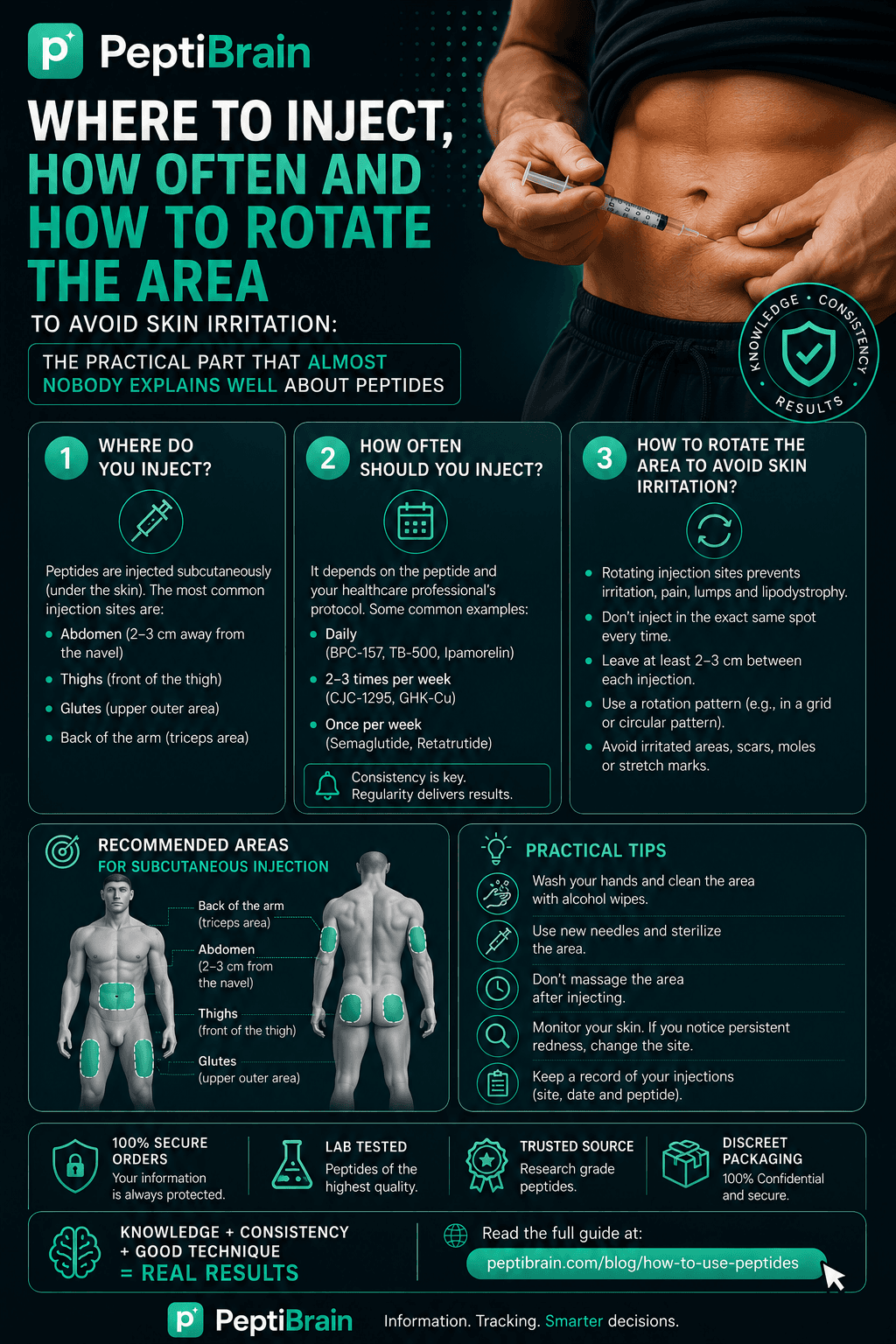
The most used sites are the abdomen (a couple of fingers away from the navel), the outer thigh, and, to a lesser extent, the back of the arm. None is exclusively “the right one” — what matters is rotating them.
Always injecting at the exact same spot can cause tissue hardening over time (known as lipohypertrophy), and makes that area absorb worse with each new application. Alternating between 3-4 different spots, a couple of centimeters apart, is common practice.
The 4 basic steps of an application
- 1Wash your hands and disinfect the area with an alcohol swab. Let it dry before injecting.
- 2Load the syringe with the exact units that correspond to your dose (never by eye).
- 3Gently pinch the skin at the chosen site and insert the needle at a 90° angle, or 45° if you have little subcutaneous fat in that area.
- 4Press the plunger slowly, remove the needle, and dispose of it in a rigid container — never in the regular trash.
This is a general overview of how a subcutaneous peptide is administered, not personalized medical instruction. The exact technique and the suitability of any peptide must be indicated by a healthcare professional.
Consistency matters more than the exact time
For daily-dose peptides (like BPC-157), applying it at roughly the same time each day helps keep a steady rhythm. For weekly-dose ones (like semaglutide), it's common to pick a day of the week and stick with it — changing days occasionally isn't serious, but losing track of when the last dose was is.
And that's where a record saves you headaches: if you run more than one peptide at a time, writing down each application (site, date, and dose) is the only way to not lose track. Our app does it in seconds and reminds you when the next one is due.