
If you start researching peptides, the same names quickly come up again and again. Here's a quick rundown of the most mentioned ones, organized by what's most researched about each.
In short: This is a rundown of the most mentioned peptides grouped by category — weight loss, recovery, muscle, longevity, and skin — covering what's researched about each, without dosing or usage recommendations.
Weight loss
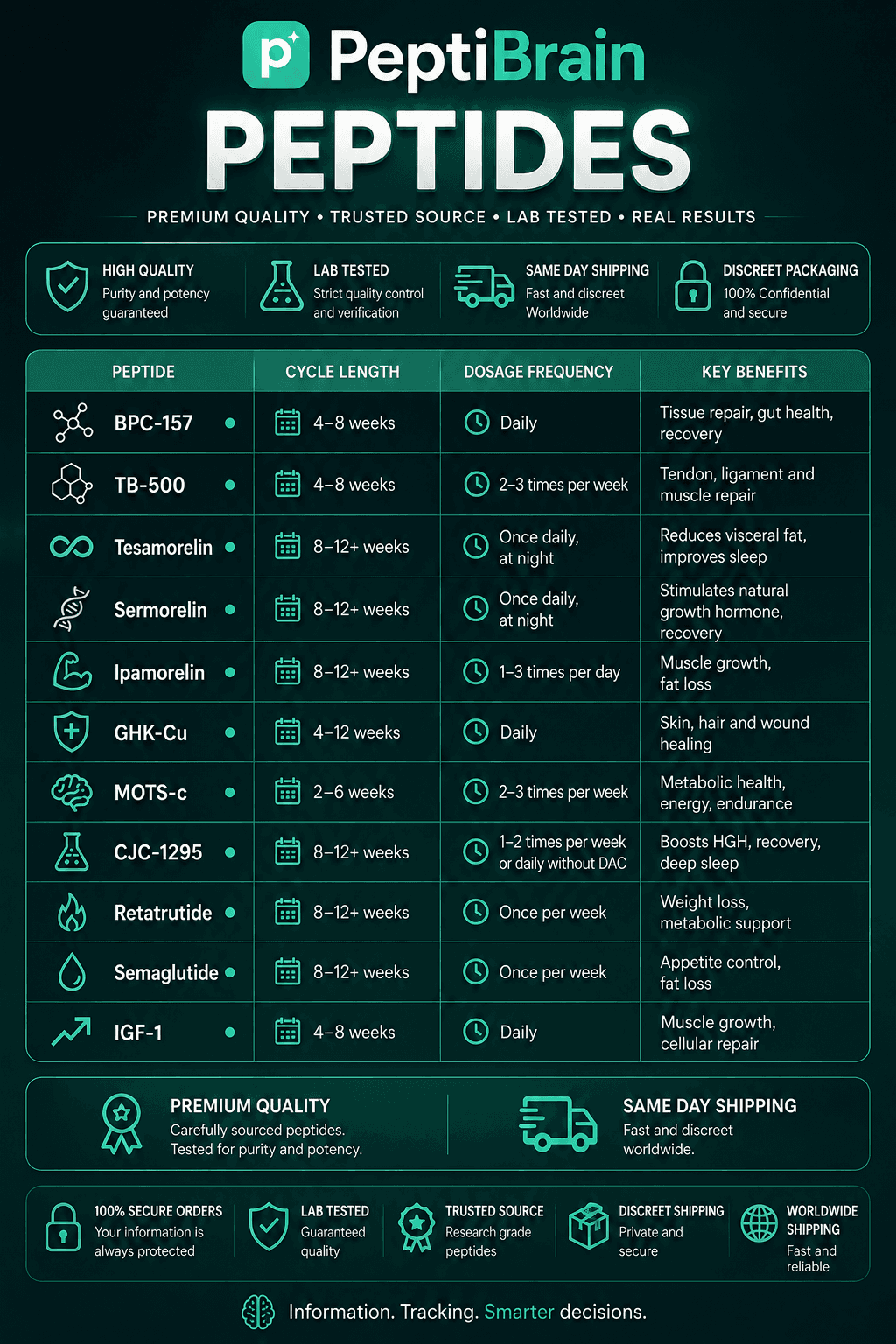
Semaglutide
GLP-1 receptor agonist. Reduces appetite, slows gastric emptying, and improves insulin sensitivity. By far the most searched-for on this entire list.
Tirzepatide
Dual GIP/GLP-1 agonist. Supports weight control and improves insulin sensitivity.
Retatrutide
Triple GIP/GLP-1/glucagon agonist, under research for weight control.
Recovery and tissue repair
BPC-157
Pentadecapeptide derived from a gastric protein. Known for its tissue repair and digestive health properties.
TB-500
Synthetic fragment of thymosin beta-4. Promotes healing, cell regeneration, and mobility.
Muscle and growth hormone
Ipamorelin
Selective growth hormone secretagogue, with a milder side-effect profile than others.
CJC-1295
Long-acting GH-releasing hormone analog. Often combined with ipamorelin.
MK-677 (Ibutamoren)
Non-peptide GH secretagogue active orally. Mimics ghrelin's action.
Longevity and anti-aging
Epitalon
Synthetic peptide derived from the pineal gland. Studied for its possible relationship with cellular aging.
MOTS-c
Mitochondria-derived peptide. Trending for its possible role in metabolism.
Skin and beauty
GHK-Cu
Copper-peptide complex naturally present in the body. Widely used in cosmetics for its association with collagen production.
This is an informational list of the most mentioned peptides, not a recommendation for use. Many are still under research and their use should happen under a healthcare professional's supervision.
Now organized by what you're after
If you'd rather see them organized by your specific goal (weight loss, recovery, muscle, anti-aging, or skin), we have a goal-based guide. And if you already know which one you want to use, our protocols guide has reference doses and frequency for each one.